In the previous releases of DAC, prune date parameter was set at the execution plan level. In DAC 10.1.3.4.1, prune dates can be set at the execution plan level for the entire plan or in the execution plan parameters for specific source connections. Dates set at the source level in the parameters override the date set at the overall execution plan level. If no dates are set at the source level in the execution plan parameters, the dates default to the execution plan level.
Friday, September 11, 2009

BI for Investing?
At times we need to take a step back and ask ourselves “what got us here” or “why did we take this path”. Just the other day I asked myself this and remembered that what ultimately drove me into the Business Intelligence realm was my passion for investing. I realized that in today’s investing there is so much data available that it can often overwhelm an active investor to the point that they cannot make a whole lot out of any of this data. Behind all this data there are so many data points of interest to the investor. We have measures such as moving averages, 52 week high, 52 week low, Golden Cross, Death Cross, these and many more can be used for determining whether or not to invest in a stock at a given time. Not only are there plenty of measures to track, but there are also many dimensions that an investor would like to have built around these facts. Outside of the obvious being time, we have stocks, options, portfolios, sectors, industries, competitors and even ETFs and Funds. So to help keep my BI passion rolling and to expand my BI horizons, I am setting out to use Business Intelligence for Investing. Stay tune as I will occasionally blog about my BI building experiences and share any tips and tricks that I encounter along the way and maybe I will give you an idea of what may be a good investment. For example, do you really think the price of natural gas is going to go much lower this Fall with what lies ahead? However, just remember that in investing there is nothing and no one (including Mr. Buffett) that is accurate 100% of the time, but if you make the right investments, you only need to be right more than you are wrong to have a positive return.
Thursday, September 10, 2009
It Has Been Decided!
BI Consulting Group will be hosting their inaugural Insight Award Happy Hour event at the Ponzu Lounge located in the Serrano Hotel downtown San Francisco, just blocks from the Moscone Center. Happy Hour event is scheduled to take place on the evening of Monday, October 12th from 7-9pm. BICG will be honoring their Insight Award winners and welcomes friends of BICG to stop by. Beverages and hors d'oeuvres will be provided, in addition to a small presentation to honor the Insight Award winners.
To check out information on the host location, go to: www.ponzurestaurant.com.
If you plan to be in San Francisco for Oracle OpenWorld, stop by the BICG booth in Moscone South, Booth 2201 - located in the front row to the right!
To check out information on the host location, go to: www.ponzurestaurant.com.
If you plan to be in San Francisco for Oracle OpenWorld, stop by the BICG booth in Moscone South, Booth 2201 - located in the front row to the right!
Oracle EPM Maintenance Release 11.1.1.3
Oracle recently put out a maintenance release for Oracle EPM products. Version 11.1.1.3 is a maintenance release for Release 11.1.1.0, 11.1.1.1, or 11.1.1.2. It looks to mainly include tighter integration of Crystal Ball into the EPM product suite (which includes Essbase).
You can download the EPM 11.1.1.3 products from Oracle eDelivery (http://edelivery.oracle.com). From the "Media Pack Search" window, select the product pack “Oracle Enterprise Performance Management System” and Platform (ie Windows). There are a lot of product packs available so be sure to select the correct one.
Note that each time a new version or maintenance release is made available, the file part numbers you download will change. The latest Essbase EPM files are shown below:
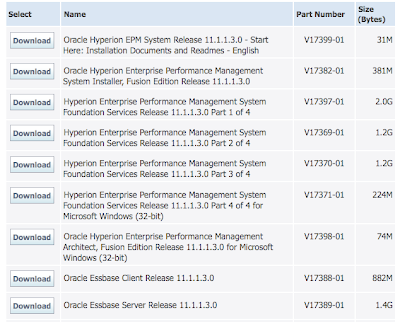
Refer to a previous post for more EPM installation guidance:
http://oraclebiblog.blogspot.com/2009/06/oracle-epm-and-essbase-installation.html
Here is a link for further information on specifics for 11.1.1.3:
http://download.oracle.com/docs/cd/E12825_01/epm.111/readme/hp_1111300_readme.html#_Toc236725005
You can download the EPM 11.1.1.3 products from Oracle eDelivery (http://edelivery.oracle.com). From the "Media Pack Search" window, select the product pack “Oracle Enterprise Performance Management System” and Platform (ie Windows). There are a lot of product packs available so be sure to select the correct one.
Note that each time a new version or maintenance release is made available, the file part numbers you download will change. The latest Essbase EPM files are shown below:

Refer to a previous post for more EPM installation guidance:
http://oraclebiblog.blogspot.com/2009/06/oracle-epm-and-essbase-installation.html
Here is a link for further information on specifics for 11.1.1.3:
http://download.oracle.com/docs/cd/E12825_01/epm.111/readme/hp_1111300_readme.html#_Toc236725005
Tuesday, September 8, 2009
The United Nations of Business Intelligence
I find many aspects of my work very fulfilling and many ways I am proud of my job. However, one of the least pleasant is the industry-standard title ascribed to the role I typically play in a BI implementation: "Business Analyst." It's probably one of the most understated job titles of all time and worse, the ultimate cocktail party conversation non-starter. Who invented the term anyway? It's stupid and I'm tired of it.
Of course the natural response would be: "You may have a point but what else would you call it?" Indeed, how else would you name this role, which by its nature has no traditional "profession" of its own but instead straddles a kind of no-man's-land between professions -- that of clients (who need the assistance of technologists to achieve business objectives) and of technologists (who perform the work required by the client)? And how to come up with something sexy to boot?
Meeting with an old college friend years ago, I tried laboriously to explain the nature of my work in the glow of a second glass of Zinfandel (or was it a third?). My friend asked me an intriguing question: Did my professional endeavor in IT have any relationship to my undergraduate experience? At the time I was over ten years out of college and a bachelor's degree in Foreign Service (aka International Relations) -- and 9/11 was still raw in my mind, so I was bemoaning the fact that I chose to pursue opportunities in software development rather than diplomacy. But, perhaps thanks to that same glow from the wine, I took a look at my job from a different angle and saw something very interesting: The IT roles that I had performed often involved a certain degree of, shall we say, mediation. Thinking it through, I realized something more fundamental: while performing various IT roles, I often perceived an acute need for mediation between the "suits" and "geeks" and I found myself drawn into fulfilling that need, partly because I liked doing it but largely because my skills were well-suited to that role.
From that point on I began to see more clearly the importance of the mediator in successful IT endeavors. Over time I have also come to believe that this role has much in common with the practice of diplomacy -- particularly within the specific discipline of Business Intelligence, where interactions between clients and technologists become uniquely more intense than in a typical IT project.
What I'd like to do first is explain the parallels I see between diplomacy and the role of the classic IT Business Analyst. Then I will take the next logical step: to explore what lessons from traditional diplomacy we can apply to the practice of Business Intelligence in particular. Hopefully I'll shine a fresh light on this important role and perhaps even inspire somoene to devise a job title that's far more sexy than "Business Analyst."
Traditional Diplomacy and the Traditional Business Analyst
In traditional diplomacy, the diplomat mediates between what I'll call "physical" nations: the US and China, for instance. A BA does essentially the same thing - but between "metaphorical" nations: the client (aka "The Business") and the technologists (aka "IT" or "Tech"). Let's consider some hypothetical characteristics of physical nations and their parallel among metaphorical nations: [Please understand that my examples are sometimes oversimplified generalities intended purely to illustrate the point and not pass value judgements on any country or group of people]
| Physical | Metaphorical | |
| Goals / interests / agenda | US: Increase industrial production; decrease cost of healthcare; decrease energy demand; promoting the global spread of democracy
| Tech: Work with cutting-edge technology and phase out old technology; build resumes Business: Increase [revenue / profit], decrease costs, build resumes |
| Language | US: English China: Mandarin | Tech: SQL, Java, HTTP, SOA, "geek speak" Business: Quarterly financial statements, Balance sheet accounting, "corporate speak" |
| Natural resources | US: Wheat, coal, consumers, Hollywood China: Cheap and abundant labor, cash | Tech: CPUs, RAM, computational thinking, technical skills, hard work, creativity Business: Money, market-oriented thinking, business skills, hard work, creativity |
| Cultural values | US: Individualism China: Collectivism | Tech: Collaboration Business: Competition |
| Currency | US: Dollar China: Yuan | Tech: Game rooms, private office space, logo wear, money Business: Titles, adminstrative assistants, corner offices, money |
| Fashion | US: T-shirt & jeans, Little Black Dress China: Mao suit, qipao | Tech: Logowear, boardshorts, Tevas Business: Business casual, suits |
Despite the oversimplifications, the parallels are compelling.
Given this common concept of a "nation," let's consider the professional challenge of the traditional diplomat:
How to foster a trusting and productive relationship between his employer's nation and other nations (at least, those that his employer considers important)...
So that his employer's nation can effectively apply its unique natural resources to pursue & fulfill its own agenda...
And the citizens of his employer's nation can be happy and prosperous.
In comparison, the challenge of the Business Analyst is basically the same but with notable differences:
How to foster a trusting and productive relationship between ALL nations...
So that ALL nations can effectively apply their unique natural resources to pursue & fulfill their agendas...
And the citizens of ALL nations can be happy and prosperous
The Business Analyst is in the unique position of being required to ensure that the interests of all nations are being satisfied. This mission is more akin to that of the United Nations Secretary General -- which is also not an easy job but I'm sure Ban Ki-Moon has an easier time at cocktail parties. And the chauffeur would be nice too.
In my experience this perspective has proven to be a useful way to understand and manage the dynamics of interactions between IT and "The Business." For my next post I will consider some specific tools and techniques of traditional diplomacy and how to apply them to a Business Intelligence practice.
Tuesday, September 1, 2009
Essbase and Use of Duplicate Members
I just returned from a client that was using a relatively new Essbase feature called "duplicate members". The business use of duplicate members is that it provides unique cube data when people use the same name to mean different things. You say "tomato" and I say "tomato", that sort of thing. Now a tomato can be either a fruit or a vegetable. Pretty cool!
This feature became available beginning with Essbase System 9 and continues on in 11x. Do not confuse this with "shared member rollups", which share the same data value in a different part of the outline. Duplicate members allow the use of the same member name in an outline, but the values are unique, not shared.
Here is an example of duplicate members. A user defines "New York" as both a state and a city in the outline but each has a unique value because they reference two different things.
Geography
--- State
------- New York
------- Pennsylvania
------- ...
--- City
------- New York
------- Philadelphia
------- ...
You must enable the duplicate members option in the outline to use this feature. Then create a qualified member name in the outline. A qualified member name consists of the duplicate member or alias name and all ancestors up to and including the dimension name. To create uniqueness, each name must be enclosed in square brackets([]) and separated by a period (.).
For instance, the qualified outline member names would be:
[State].[New York].
[City].[New York].
This is a brief introduction to this valuable feature. Refer to the Essbase Database Administrators Guide for specific details on how to create duplicate members. Here is the link: http://download.oracle.com/docs/cd/E10530_01/doc/epm.931/html_esb_dbag/frameset.htm?dotdimb.htm
This feature became available beginning with Essbase System 9 and continues on in 11x. Do not confuse this with "shared member rollups", which share the same data value in a different part of the outline. Duplicate members allow the use of the same member name in an outline, but the values are unique, not shared.
Here is an example of duplicate members. A user defines "New York" as both a state and a city in the outline but each has a unique value because they reference two different things.
Geography
--- State
------- New York
------- Pennsylvania
------- ...
--- City
------- New York
------- Philadelphia
------- ...
You must enable the duplicate members option in the outline to use this feature. Then create a qualified member name in the outline. A qualified member name consists of the duplicate member or alias name and all ancestors up to and including the dimension name. To create uniqueness, each name must be enclosed in square brackets([]) and separated by a period (.).
For instance, the qualified outline member names would be:
[State].[New York].
[City].[New York].
This is a brief introduction to this valuable feature. Refer to the Essbase Database Administrators Guide for specific details on how to create duplicate members. Here is the link: http://download.oracle.com/docs/cd/E10530_01/doc/epm.931/html_esb_dbag/frameset.htm?dotdimb.htm
BICG at Oracle OpenWorld
Check out the BI Consulting Group exhibit at this year's Oracle OpenWorld. Located in Moscone South, Booth 2201. You will have the opportunity to meet with the BICG management team and get firsthand insight on how their in-depth experience can better serve your company.
Oracle OpenWorld runs from October 11-15, dates and exhibit hours below.
Monday, October 12th: 10:30am - 6:30pm
Tuesday, October 13th: 10:30am - 6:30pm
Wednesday, October 14th: 9:15am - 5:15pm
BICG will host their inaugural Insight Award winner event on the evening of Monday, October 12th. Event details yet to come!
Oracle OpenWorld runs from October 11-15, dates and exhibit hours below.
Monday, October 12th: 10:30am - 6:30pm
Tuesday, October 13th: 10:30am - 6:30pm
Wednesday, October 14th: 9:15am - 5:15pm
BICG will host their inaugural Insight Award winner event on the evening of Monday, October 12th. Event details yet to come!
Subscribe to:
Comments (Atom)